
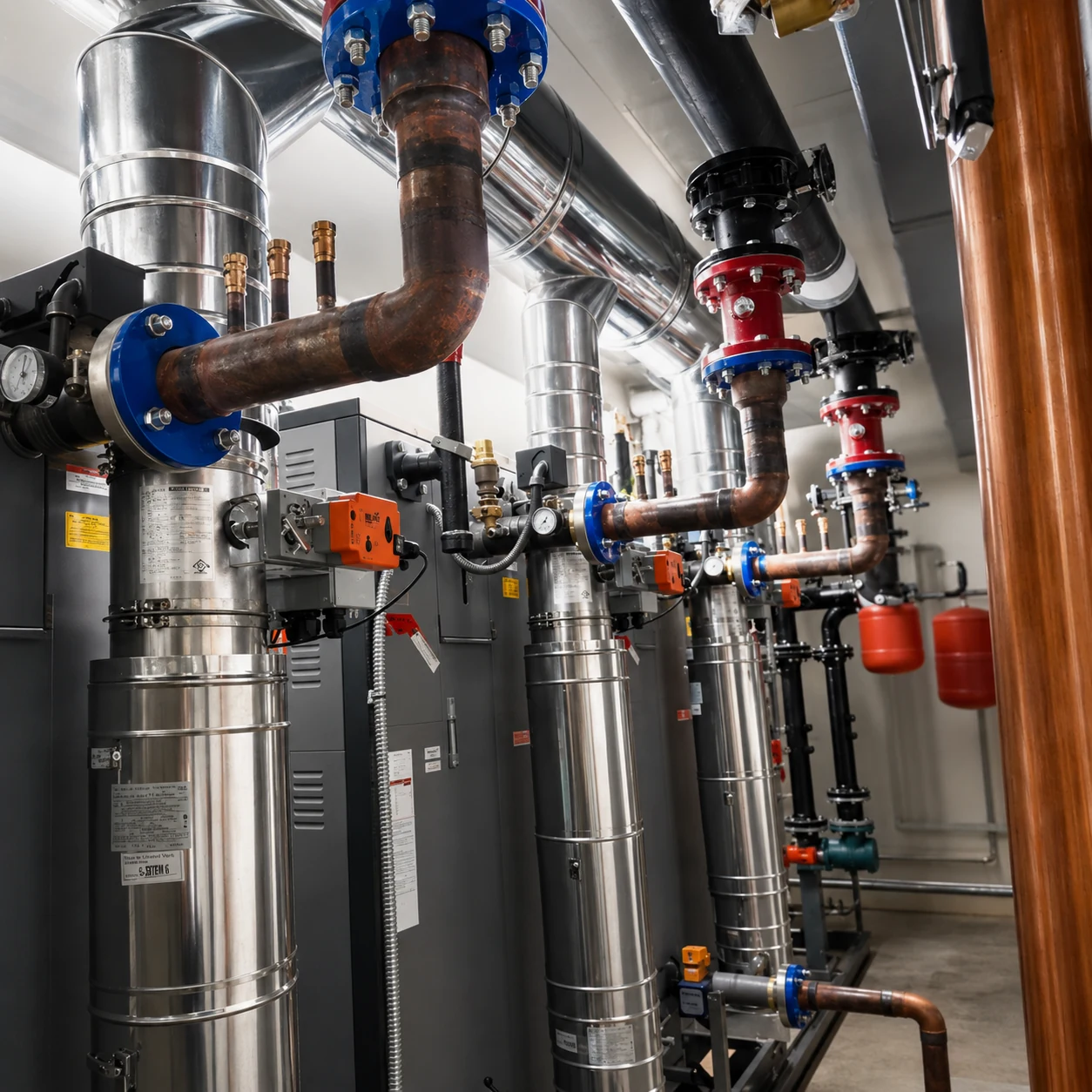
SMDS Damper System: University Student Housing
Holding a 0.00” to +0.20” W.C. draft window across three modulating condensing boilers on a single 60′ stack.
- Application
- University student housing
- Appliances
- (3) 2,000 MBTUH condensing boilers
- Draft Window
- 0.00” to +0.20” W.C.
- Common Header
- 16” ID
- Vertical Rise
- ~60 ft.
- System Turndown
- 30:1 (10:1 per boiler)
The Challenge
A recent university student housing project planned to common-vent three high-efficiency condensing, positive-pressure (Category IV) boilers through a 16” ID header rising ~60 ft. On the surface it looks like a straightforward common-vent. In practice, today’s modular condensing boilers force a complex balance of pressures: each appliance demands a tight 0.00” to +0.20” W.C. draft window at its flue outlet, while heating input swings from 6,000 MBTUH down to 200 MBTUH (30:1 system turndown) and ambient temperatures shift +/-10°F throughout the day. Enervex draft software returned a gravity-vent range of −0.086” to +0.131” W.C., outside the boilers’ spec at low load. A second problem: because the appliances are positive-pressure, flue gas from running boilers will back-feed into offline boilers through a shared header. The ASHRAE Chimney Design Equation assumes steady-state and can’t resolve this; a gravity solution wasn’t possible.
The Solution
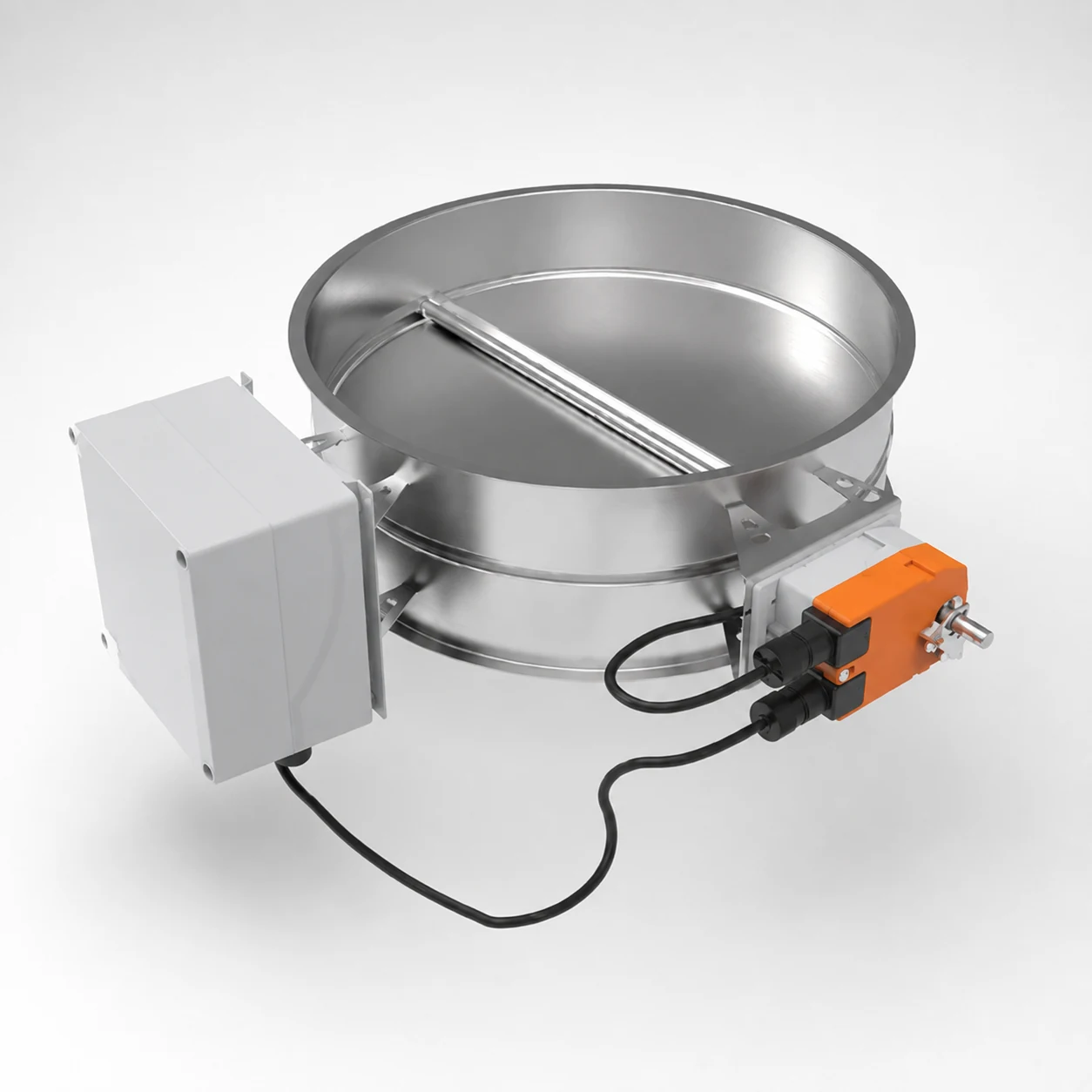
EXD (formerly ENERVEX Northern California) specified a Sealed Modulating Damper System (SMDS) at the outlet of each boiler. A bi-directional pressure sensor reads the boiler connector and modulates the damper to hold the required outlet pressure, positive or negative, across the full 30:1 load range. The UL-listed damper provides a 100% seal-tight closure rated to 1400°F and 60” W.C., so when a boiler is offline its damper closes completely and blocks back-feed from the active appliances. An integrated EBC24 controller runs the damper logic at each appliance and ties into the boiler’s safety interlock wiring to satisfy CMC requirements for mechanical-draft venting.
The Result
All three condensing boilers now share a single 60′ common vent while each appliance sees draft inside its 0.00” to +0.20” W.C. specification, at full fire, at minimum fire, and through ambient temperature swings. Offline boilers are sealed off from the active flue, eliminating back-feed. The system meets CMC mechanical-draft interlock requirements without oversizing the header or adding a stack fan.
East Bay Housing Authority
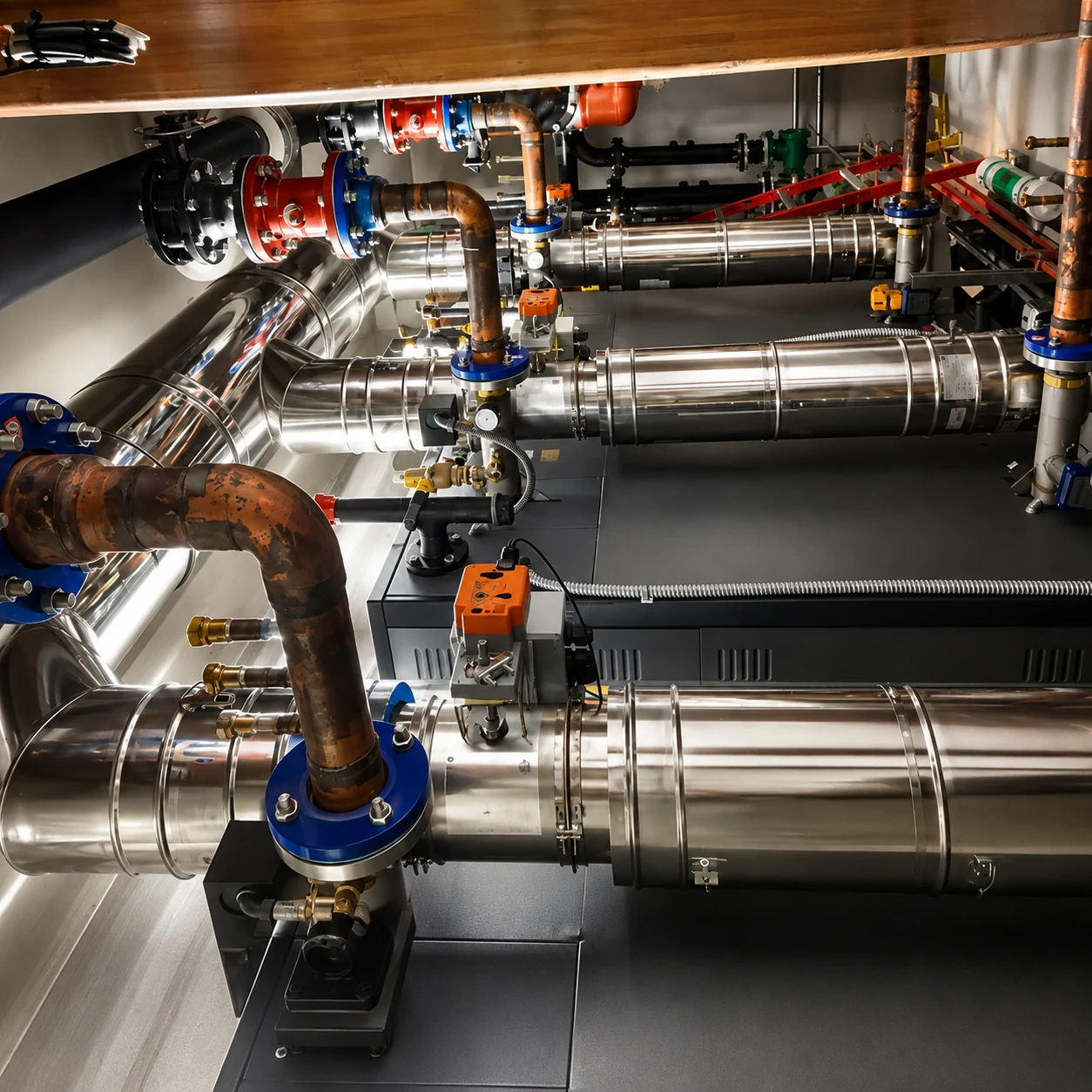
Common-venting two Cleaver-Brooks hot water boilers and two Cochran steam boilers through a single 16” chimney, with back-to-back IPVB 500 fans for redundancy.