
2164 Hyde Street
Preventing condensate from disintegrating a masonry chimney.
- Location
- San Francisco, California
- Completion
- June 2016
- Owner
- Multifamily Private Residence
- Contractor
- ACCO Engineered Systems
- Mechanical Engineer
- None
- Enervex Rep
- Enervex Northern California
The Challenge
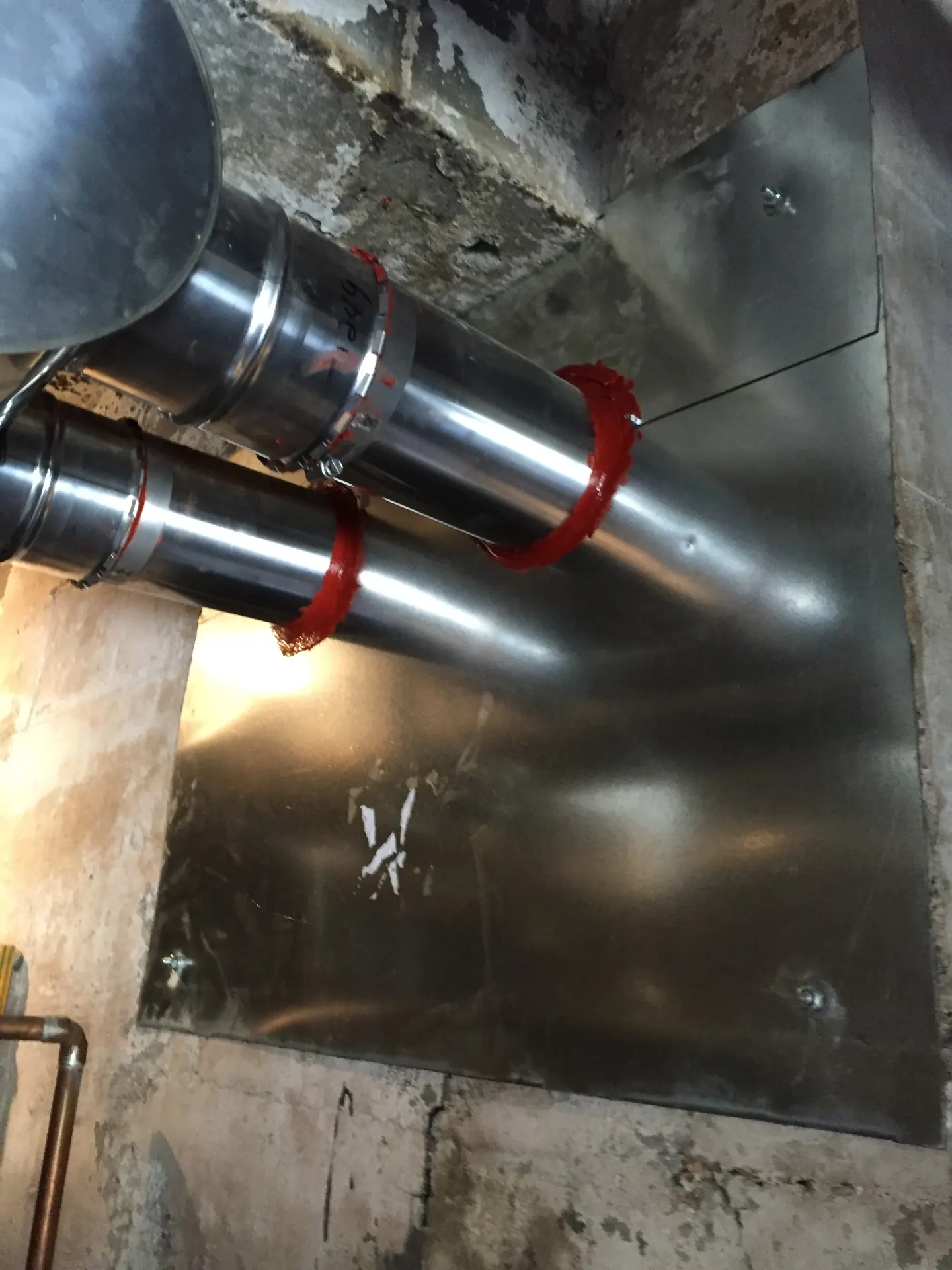
For historic buildings in San Francisco, mechanical spaces are often converted in phases, which leads to equipment problems. At 2164 Hyde St., an existing Peerless LC steam boiler ducted into a 120-foot masonry chimney was condensing flue gases inside the stack. The acidic condensate was deteriorating the inside liner of the masonry. As heat from the exhaust gasses gets reduced by a relatively cold masonry chimney, particularly following periods of non-operation, the exhaust gas temperature drops below the dew point and condenses. The appliance was rated for Category I non-condensing applications, not Category IV, so the venting was not designed to handle acidic condensate. Left alone, condensate would eat through the liner and structurally weaken the chimney. To complicate matters, the masonry chimney was split into two 5” × 7” shafts, no room for a standard 10” dia. single liner to meet the 10” boiler exhaust connection.
The Solution
Using the available shaft spaces, ENCA designed a liner system with two 5” dia. shafts. Preliminary draft calculations indicated a significant natural draft (<0.4” W.C.), which would typically demand a modulating damper to counteract the extreme negative pressure. With the two 5” sections, however, the extra pressure drop risked combustion issues in the appliance. Draft calculations concluded that an Enervex TDF250 inline fan system would overcome the back pressure and induce the required draft at the appliance outlet. Because the liner sections weren’t in contact with the masonry, condensate was still a concern over the extremely long run and low San Francisco temperatures, so we chose a Category IV vent system with an AL294C inner wall, highly resistant to acidic condensate. A flexible liner was supplied in 25′ sections to be lowered down the chimney, cutting installation time and cost.
The Result
The engineered mechanical draft fan system and chimney liner delivered safe, continued operation of the boiler with zero aesthetic impact to the historic building. On-site coordination between Enervex NorCal and the installing contractor ensured the flue and fan layout fit a tight mechanical room. The Enervex EBC30 controller monitors pressure at the boiler outlet and maintains a slight negative draft by ramping the TDF250 fan up and down as needed. The boilers run properly, and the historic chimney is preserved from flue-gas acidity.
“Prior to Enervex Northern California getting involved the boiler flue gasses were deteriorating our masonry chimney and we needed help to identify a long-term solution. They responded quickly with a tailor-made solution that lined the chimney and minimized any aesthetic impact to the building.”
SMDS Damper System: University Student Housing
Three high-efficiency condensing boilers, one 60′ common vent, and a 30:1 turndown, held in spec by a Sealed Modulating Damper at each appliance outlet.